 Customer Care
 1-800-103-3723 / 080-4552-0100
 Say Hi to 97467 97467
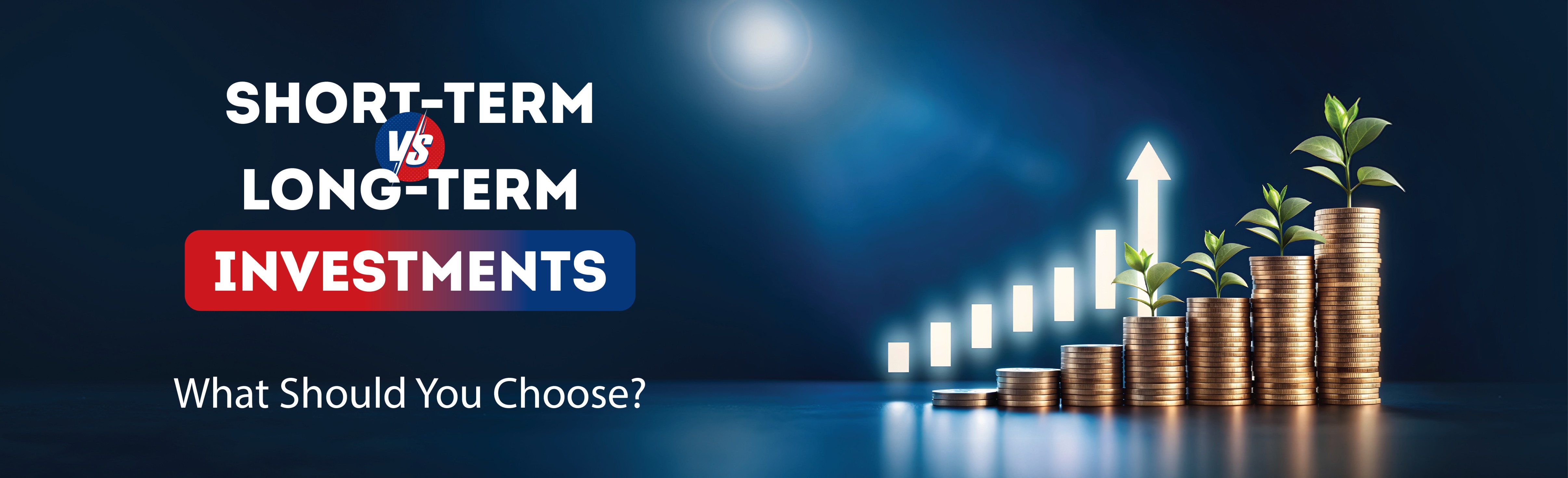
When it comes to managing your money, you may often ask yourself: Should I invest for the short term or the long term?
The answer depends on your financial goals and when you might need access to your money. Some investments help you manage immediate needs, while others are designed to support your future plans. Understanding short-term vs long-term investments can help you choose the approach that works best for your financial journey.
Long-term investing means setting aside money for several years with the goal of building financial security over time.
If you are planning for milestones such as buying a home, supporting your family’s future, or preparing for retirement, long-term investment options may be suitable. Since these investments remain for a longer period, they allow your money more time to grow.
Many individuals choose options such as Fixed Deposits (FDs) as part of their long-term planning. FDs allow you to invest a lump sum amount for a fixed tenure while earning predictable returns.
Another option often considered is a Recurring Deposit (RD). An RD allows you to invest a fixed amount every month, making it a convenient way to build savings gradually over time.
In simple terms, long-term investing is about giving your money time to grow steadily.
Short-term investing focuses on financial goals that are closer in time. These investments are usually held for a few months to a few years.
For example, you may want to save for travel, education expenses, or keep funds ready for unexpected situations. In such cases, short-term investment options help you keep your money accessible while still earning returns.
Many people rely on a Savings Account for their short-term financial needs. It allows you to access your money easily while earning interest on your balance.
Short-term investing is mainly about flexibility and liquidity.
To better understand short-term vs long-term investments, it helps to compare their key features.
| Feature | Short-Term Investments | Long-Term Investments |
|---|---|---|
| Investment Duration | Few months to around 3 years | Typically 5 years or more |
| Purpose | Managing near-term expenses or emergency funds | Building wealth and achieving long-term goals |
| Risk Level | Usually lower risk | May involve short-term fluctuations |
| Returns | Generally moderate | Potentially higher over a longer period |
| Liquidity | Easy access to funds | Funds remain invested for longer |
| Examples | Savings Accounts, short-term deposits | Fixed Deposits (FDs), Recurring Deposits (RDs) |
Both short-term investment options and long-term investment options play important roles in financial planning.
For many people, the best strategy is not choosing one over the other but creating a balanced mix.
You may keep some money in a Savings Account to manage daily financial needs or emergencies. At the same time, allocating funds to Fixed Deposits (FDs) or building savings through a Recurring Deposits (RDs) can help you plan for future financial goals.
Combining short-term investment options with long-term investment options can provide both flexibility and financial stability.
Long-term investments may be suitable for individuals who are planning ahead and can stay invested for several years.
If your goals include building financial security, preparing for retirement, or supporting major life milestones, exploring long-term investment options such as Fixed Deposits (FDs) or Recurring Deposits (RDs) can help you stay on track.
These options support disciplined saving and gradual financial growth.
Short-term investments can be useful when you want your money to remain easily accessible.
If you are saving for an upcoming expense or want to maintain funds for emergencies, short-term investment options may be more suitable. These investments allow you to maintain liquidity while still earning returns.
Savings Accounts are commonly used for such purposes as they offer flexibility and convenience.
Imagine receiving your monthly salary. After covering your regular expenses, you may still have some money left to save or invest. Instead of keeping all of it in one place, you could divide it in a way that supports both your present needs and future goals.
For example, you might keep a portion of your money in your Savings Accounts. This helps you manage daily expenses and ensures that you have funds available for unexpected situations. In this way, your savings account supports your short-term investment options by keeping your money accessible.
At the same time, you could set aside a fixed amount every month in a Recurring Deposits (RDs). This allows you to build your savings gradually and work towards goals that may be a few years away.
If you receive additional income such as a bonus or incentives, you might consider placing a part of it in a Fixed Deposits (FDs). ). This helps your money grow steadily over a longer period and supports your long-term investment options.
)By doing this, you are not choosing between short-term vs long-term investments. Instead, you are using both strategies together.
Keeping some money accessible while also investing for the future can help you create a balanced financial plan that supports both your immediate needs and long-term aspirations.
Understanding short-term vs long-term investments can help you make smarter financial decisions.
Short-term investments help you manage immediate financial needs, while long-term investments help you prepare for the future. Instead of choosing only one strategy, many people benefit from combining short-term investment options with long-term investment options.
By maintaining accessible savings while also investing through options such as Fixed Deposits (FDs) or Recurring Deposits (RDs), individuals can create a financial plan that supports both present needs and future goals.